
Concepts
the Milena principle organized a variety of artistic and cultural events connecting people throughout Europe in the last decade. We built a network of international partners in more then 15 countries, including private persons, cultural institutions, universities and museums, all established through personal contacts. The majority of activities were realized on basis of voluntary work of our team and international partners, with no or little money nor governmental help. Our target public varied from children to senior citizens, often connecting them internationally.

Here some of our leading concepts:
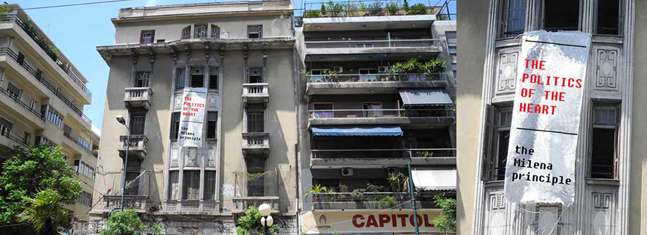
 The Politics of the Heart ⋈ being strong in our weakness.
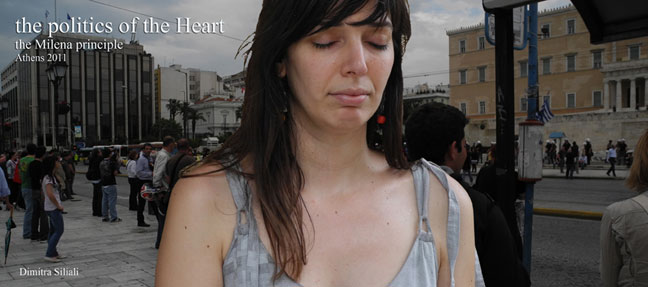
[ The Politics of the Heart ] :a multidisciplinary field of community. What if politics would become a poetical instrument? What if nature would be our forum out of which we would give shape to society? One of the aims of the Milena principle is to create a forum for cross-border activities, working with politics as a poetic, creative and human instrument. As 'artists-nomads of a new era' we are moving in a field of art, ecology, philosophy and politics, fed by utopian ideas. Concepts as "solidarity", "connection" and "togetherness" are for us an inexhaustible source of inspiration. Our aim is to organize seminars, workshops and events with participants from different areas. Our recent activities with students and artists in Athens and Dresden / Jahnishausen are based upon these ideas.
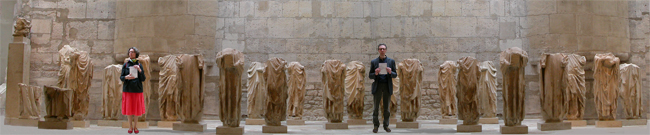
In this way a thought is expressed which exteriorizes a form of art that does not want to explain but rather becomes an instrument of experience, a form which does not pretend to want to fight its existence or run from it, but one which values experience. This form of art is not based on exhibiting the human sorrow in our society, a sorrow that is unmistakably present in our environment and in political world events. It is a form of art, which is autonomous and tries to offer alternatives, which based on the thought for fellow man want to give a positive impulse to society.
2008 became the point of no return: for the first time in history there are more people living in cities than in rural areas. Cities will grow even larger due to climate change and to environmental migrants, who are destined to become the new humanitarian emergency of the planet in the next few decades. The United Nations projects that the worldʼs urban population will reach 5 billion people by 2030. The mass movement of people away from rural areas and urbanisation have resulted in the formation of "unplanned" megacities particularly in countries in the southern hemisphere.
According to forecasts by the United Nations and IOM [International Organisation for Migrations], in 2050 the Earth will have to face the trauma depicted by 200 million environmental migrants: people who will not 'land' in the richer nations, but will look for new ways of livehood in the urban areas of their home countries, which are already overcrowded and often extremely poor. They are environmental migrants and they are people. They are losing their land, their traditions. International political agendas don’t talk about it. 90% of this kind of migration will occur literally in les developed countries, with relocation from rural areas to the more degraded areas of the city known as slums.
Environmental migrants will manage to escape from environmental stresses and look to create chances of a better life in future (mega)cities? In many of these cities, questions of social and environmental sustainability have thus become extremely pressing. What particular environmental and social problems are these rapidly growing cities in the Global South confronted with? What are potential solutions? How could models for social and environmentally sustainable urban development?
The Dürer Connection ⋈ the path of Albrecht Dürer.
![Albrecht Dürer [1471-1528]](afbeeldingen/durer_self.jpg "Albrecht Dürer [ 1471 - 1528 ]")
A network based on the nomadic aspect typical of the former renaissance artists, who did not only travel with their works throughout Europe, but also made connections with the places they visited. Albrecht Dürer [1471-1528] visited Antwerp in 1520: the Milena principle wants to actualize this old tradition. These great renaissance persons found each other via their common interest and thinking. Through their travels they moved boundaries, they travelled with and via ideas. Through exchanges of ideas with artist friends, whom they visited during these long journeys, they created a network of solidarity and affinity.
Curator Artemis Potamianou (MOMA & Tate London), who is currently based in Athens, considers the Milena principle as one of the 49 most important independent art platforms from all over the world, distinguishing themselves by working on unconventional ways and by establishing unexpected and influential debates on art. Based on the “unity is strength” principle, the platforms have secured their own place on the international art arena without antagonizing the environment they are called upon to serve.
the Milena principle focuses on the ongoing travelling project "the Dürer connection" [2003 - ], developing itself as an European nomadic network , initiating collaborative encounters between public, experts and artists, referring to the Flemish renaissance, when artists, philosophers and scientists traveled unceasingly, connecting with people and places. Exchange of ideas and continuous journeys created a network of solidarity and affinity. The projects refer to this utopian and human dimension, with traveling as an artistic instrument, with events and exhibitions realized in Germany, Holland, Portugal, Poland, Spain, Italy, Czech Republic, Romania, Austria, Serbia, Slovenia, Bosnia and Herzegovina, Albania, Kosovo, Macedonia, Greece, Crete, parallel events in Latin America, as well bringing artists and people from many European countries to Belgium.
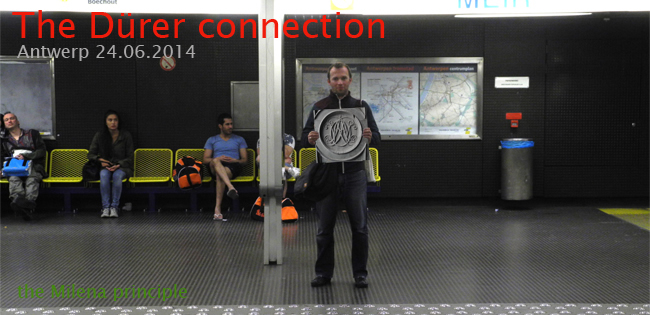
All events are linked with 'the Dürer connection', a guideline within the projects of the Milena principle, referring to the nomadic aspect of renaissance artists, travelling with their work through Europe and making connections with the places they visited and with the people they met. Renaissance artists, scientists and philosophers exchanged ideas on a border crossing way and in an atmosphere of friendship, during mutual visits on their continuous journeys. Our art projects connect explicitly with this European, utopian and human dimension.
The aspect of the artist as a ‘playing human being’ leads to conditions which enable the artist to discover and grow. This laboratory, the search as an interiorized process, results in wanting to see more in the reality surrounding us, with the work of art as an end result that gives shape to these thoughts. The 'Path of Dürer' is about an inner journey, a searching trip, the nomadic elements of being on the road. Every gesture which makes sense is evidence of the extra element in reality. We want to consider this gesture artistically and let it grow. The creative energy does its job.
'Happenings' or 'Perfomance' ? ⋈ Life and art connected.
We prefer to talk about a 'happening' [or 'action'] rather than 'performance'. Most of our actions we do are unanounced and taking place in the public space. We see the acts with the body as an artistic instrument in the field of art and personal concepts. It is a natural extention of our being as a person and artist. There is no separation between diciplines.
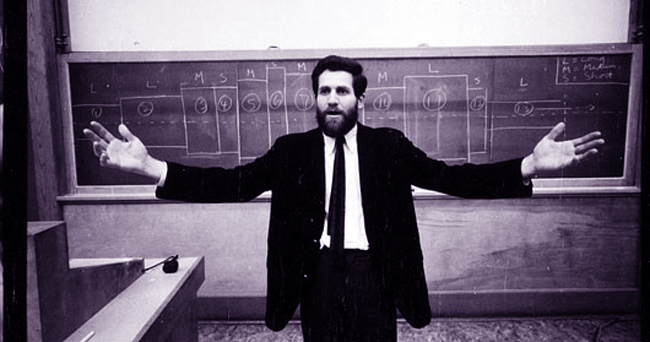
Allan Kaprow [1927–2006] was the first to introduce the therm 'Happening'. Kaprow's work attempts to integrate art and life. Through Happenings, the separation between life, art, artist, and audience becomes blurred. The "Happening" allows the artist to experiment with body motion, recorded sounds, written and spoken texts, and even smells. One of his earliest "Happenings" was the "Happenings in the New York Scene," written in 1961 as the form was developing. Kaprow calls them unconventional theater pieces, even if they are rejected by "devotees" of theater because of their visual arts origins.
Kaprow was an American painter, assemblagist and a pioneer in establishing the concepts of performance art. He helped to develop the "Environment" and "Happening" in the late 1950s and 1960s, as well as their theory. His Happenings [ some 200 of them] evolved over the years. Eventually Kaprow shifted his practice into what he called 'Activities', intimately scaled pieces for one or several players, devoted to the study of normal human activity in a way congruent to ordinary life. Fluxus, Performance art, and Installation art were, in turn, influenced by his work. In this particular text, he uses the term "happening" for the first time stating that craftsmanship and permanence should be forgotten and perishable materials should be used in art.
The "Happenings" first started as tightly scripted events, in which the audience and performers followed cues to experience the art. To Kaprow, a 'happening' was a game, an adventure, a number of activities engaged in by participants for the sake of playing. Furthermore, Kaprow says that the Happenings were "events that, put simply, happen. There was no structured beginning, middle, or end, and there was no distinction or hierarchy between artist and viewer. It was the viewer's reaction that decided the art piece, making each 'happening' a unique experience that cannot be replicated. These "Happenings" represent what we now call New Media Art. It is participatory and interactive, with the goal of tearing down the wall a.k.a. "the fourth wall" between artist and observers, so observers are not just "reading" the piece, but also interacting with it, becoming part of the art.
Ecology ⋈ silent workers network.
Ecology has always been one of the conceptual foundations of the Milena principle. All projects are starting from an ecological approach. We are working with environmentalists, arts centers that combine art and ecology in their functioning like the convent of Tibães in Portugal, Der Wachsblock [ Guido Stemme and Christian Hardt ], Ingrid Pee [Kassel Germany ] and the Accademia Dantesca [the ecological community of Jahnishausen, Germany ]. The Castle Jahnishausen will be a meeting place between artists, cultural experts and ecological and environmental workers and act as an interdisciplinary center with projects open to participation for a large public.
Ecology as a state of mind: indecision about [or ignoring] the remediation of contaminated sites is a metaphor for 'postponing the future'. When we understand that our existence is dependent on the environment around us, then naturally our concern and care for the environment becomes strong.
How does one “green” an economy? For governments seeking a cleaner, more efficient, and ultimately more sustainable pathway to economic prosperity, this question entails both promise and great challenges. For one, the scale of transformation it requires is exceptionally daunting: in his 2011 State of the Union speech, for instance, President Barack Obama called on the United States to generate 80 percent of its electricity from clean energy sources and to give 80 percent of Americans access to high-speed rail, both within 25 years. Compared to where the country stands now, these objectives presuppose unprecedented levels of investment in new infrastructure, new technologies, and relevant skills and education; yet at the same time, they also hold the prospect of new opportunities for job growth, innovation, industrial efficiency, and energy independence. With that in mind, one will invariably wonder, is such a transformation feasible at a time of constrained public budgets and slowly recovering economies? And perhaps more importantly, are the expected benefits of such a green transformation compelling enough to persuade a public that is exposed to conflicting messages about the underlying rationale, is critical of new regulation and expenditure, and generally is disillusioned with political authority? Fortunately, the green transformation of economies is no longer a theoretical concept. Today it is not only saving the earth: we also need to shape a new civilization model.
The societal shift towards a sustainable lifestyle is currently the greatest challenge facing all of us regardless of where we live. How do we want to live in the future, how can and should we live without destroying the very foundation of our lives? How can we learn to think in new ways? But most importantly: how do we transform knowledge into action? How can we take action in light of the complexity of global interdependencies?
On the limits of individual action: what role can and must individual changes in behaviour play in the transformation to a sustainable future?
What could an ecological art of living look like? How can we get there – how do we have to change our behaviour, what can we contribute as individuals? What new interpretations and concepts do we need?
.jpg)
.jpg "performance")
.jpg "the Grunewald Variations Berlin 2006")
Growing Silence ⋈ silence as an instrument of experience.
A project to promote the qualities of silence and space in an urban context. Our project is about the experience and importance of urban silence and the connection between space and silence.
Not the physical definition of silence, or the acoustical definition counts. Through a phenomenological approach to silence the artists explore how sound unambiguously works on the human being (in this case in an urban context). Silence is an instrument of experience and as well as an instrument of knowledge.
The project wants to realize a cultural bridge between the presence of silence as access to historical and natural soundscapes and the inner experience of silence. Silence is not limited to a material-accoustical aspect, silence is as well a part of city life as an inner space, a breating space.
This project tries to involve young people in the making of and creating of (urban) silence. We invite students and young artists into the design process and try to engage them in the future development of their environment and to excite them about the city. Approaching silence will explore silence in the city, looking for design tools for the shaping of places and urban experiences.
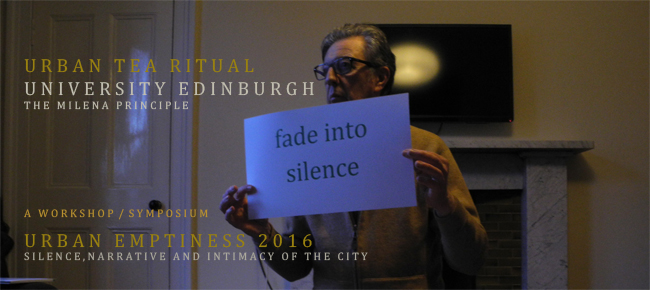
Some members of the Milena principle already are working for years with the theme of "silence". In 1993 visual artist Stefaan van Biesen realised a silence project in an urban context in his homeland: "Deafening, Silence". the MIlena priciple is making a connection with silence artist: they are a source of inspiration. Like for example: Joseph Beuys, James Lee Byars, or the Spanish artist Tres Silencio, [ one of the European living icons of silence and art ].
the Milena principle is working together as a collective of sound artists, visual artists, anthropologists, musicologists and developers on projects focused on sound, auditive memory and the ethical concerns of cultural action. They use open source technologies as a key concept for social activation. They realize interactive sound maps, sound walks, sound installations, performances, connecting visual arts with sound art and other activities linked with the preservation of sound memory, the acknowledgment of intangible cultural heritage, the encouragement of listeners’ involvement in the composition of the sound heritage.
If you want to know more about our silence projects: http://www.themilena.com/silence.html
Ervery human being an artist ⋈ a track of memories that connects us.
In this memory track we refer to ‘the birth of the tragedy’, Friedrich Nietzsche’s first publication, in which he focuses his field of vision on the Pre-Socratic period, the period during which one departs from a moving, changing world. Heracleitos states that as a human being one finds oneself in a constantly streaming river. With ‘the birth of the tragedy’ Nietzsche starts a return to this original time of movement and change. With this, a second renaissance of a philosophic culture starts, which had been regarded as primitive for hundreds of years.
We see the German artist Joseph Beuys [ 1921- 1986 ], as a central figure in this second renaissance. In the early bud of this new renaissance one finds a figure like Caspar David Friedrich, who already points to this change, as a forerunner. The landscape becomes autonomous, a world on itself without using any religious symbolism or connotation. It shows an inner world. It is the visualized experience of the tragic human being, the experience of a lack.
Throughout history one finds figures, who find themselves time and again within this range of ideas or world view. This continuation of an unmistakable tradition within the art philosophical way of thinking keeps on growing further. It is anything but maintaining an existing world view, rather an actualization of the discovery of the human and creative process. This is in the finding of oneself and the passing on of this finding oneself, not passing on content but experience, a process. Just like Joseph Beuys passed on the torch.
Water Carrier [ for I am water now ] ⋈ Urban Tea rituals - culture lab.
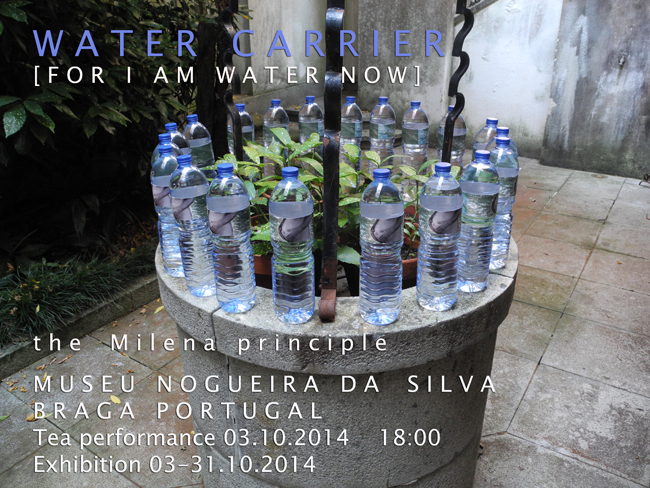
An art project in various European cities with the underlying thought that we are water. Central activity in Braga Portugal is an art performance based on a tea ritual. Parallel event is an exhibition depicting a flow of drawings, prints and videos and an installation in the Museum Nogueira da Silva in Braga 2014.
A tea ritual as an utopic field of democracy
We redefine the tea ritual on an artistic way as a philosophical and artistical meeting place, a resonating field of visual poetry and togetherness in a “politics of the heart', incorporating the utopic desire to a harmonious living together, an unconditional engagement in a field without distances, nor hierarchy. It is the echo of a humane democracy that is lost in our world.
The tea ceremony is multidisciplinary. Conversations, sound, soundscapes, smell, gestures are integrated. Parallel events are a series of performances and talks based on the topic and an exhibition with a flux of drawings, prints and the video-performances “We wish we were like water” (Braga, Museu Biscainhos 2010), Writing in water (Venice Biennale 2007) and Liquid islands (Venice Biennale 2011) next to the video-poems “Antarctica” (Brasilia, 1a Feira Intercional do Livro / Museu Nacional) connected.
When tea is more than a drink and the tea ceremony is understood and practiced to foster harmony in humanity, promote harmony with nature, discipline the mind, quiet the heart, and attain the purity of enlightenment, the art of tea becomes teaism. The term "chadao" has two words, the first being 'tea' and the second the Chinese loanword tao/dao/ native suffix -ism (also Japanese: 主義), and could thus be read as 'teaism'. Another, more literal reading of the word is the 'way of tea' (茶 tea and 道 way), comparable with for example 弓道; the way of the bow. The term can be used to describe tea ceremony as the interests in tea culture and studies and pursued over time with self-cultivation. Teaism is mostly a simplistic mode of aesthetics, but there are subtle insights into ethics, and even metaphysics. Teaism is related to teamind. A sense of focus and concentration while under the influence of great tasting tea.
Tea rituals as a philosophical meeting place, a resonating field of poetry and togetherness. Again: 'the politics of the Heart'...
If you want to know more about Water Carrier projects: http://www.themilena.com/water_carrier.html
Tempus Fugit-Hourglass [ 24 hour exhibition ] Traveling art projects on location.
The concept of a 24 hour art project is an interesting premise. It is a pop up event. The temporary nature and intensity of such events do not work as a mirror of the contemporary informative transience. But by creating a field of timelessness within a measured time in which concepts like 'silence', 'slowness', 'the body as unit measure' among others get a place. This concept of an exhibition as an event, a process in a short time span, integrates both showing the works of art and having performances take place, which are inspired by the place or the happening itself. The visitors are invited to participate in the event. They complete the exhibition by their presence. The audience is becoming the work of art.
'About melancholy' The Campagne Drongen Belgium 2004.
An exhibition as a lab [ Amsterdam 2006 ⋈ a living room / artistic pop up events ]
At the end of July 2006 the Milena principle was invited to be the guest of the German artist Niki Fröhling in Amsterdam. This ‘Tafel der Ontmoetingen’ (= Table of Meetings) was the provisional first tailpiece of their collective ‘Gepäckträger’ (= Luggage carrier) Project (how long is now) that started in Berlin in the beginning of July 2006. The artists of the Milena saw each other again for the first time in Amsterdam after their wanderings in Europe. A 24 hour exhibition was realized starting from interaction and dialogue, taking advantage of place and time. The theme was 'Bewoner van steden' (= Resident of cities). Again this exhibition was realized as a laboratory. In this exhibition new works of art were realised with minimal means in situ, forming part of an easily transportable and light travelling exhibition. The day before Geert Vermeire had described drawings of Stefaan van Biesen, which they had made during their stay in Berlin. Printed photo material of the ‘Watercurtain-performance’ in the Bellevuepark and the 'Grunewald Variations' in the Grunewald in Berlin were described and provided with notes and then hung on the walls of the rooms.
The Table of Meetings [ a room as a meeting place ].
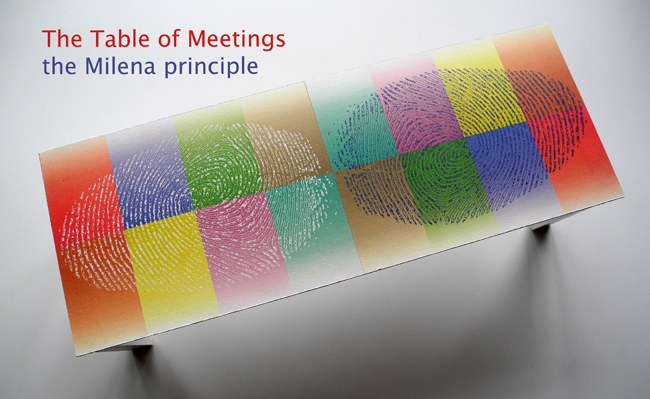
The path of Albrecht Dürer / a Table of Meetings
Albrecht Dürer [1471-1528], artist, mathematician & theorist, traveled systematically through Europe, visiting both North and South on various journeys. We are inspired by the nomadic trajectories of him and other figures, finding each other over international borders via common interest and ideas, creating networks of solidarity and affinity, working and creating in places they visited, meeting with / living together with the people they met.
Within this framework we intend to redefine art in public places via a travelling project with personal communication and human dialogue as creative instruments.
Departing from a “Table of Meetings”, a transportable table for multidisciplinary events, to pass on, adjustable to any number of people. The surface of the table is marked with a large fingerprint referring to identity, respect for it and sharing it. A "table of meetings" invites to open yourself for the other and others,. Through the table we redesign the concept “public space”, as space of people, recreated with a travelling and moving table through the city, an instrument of sharing, passing on by people.It invites to an intimate debate, to write on it, becoming a surface that passes on as a letter to others. As well a table creating space(s) for strangers. A table of hospitality, a human and social statement. A meeting place in an utopic field, a world table, where cultures come together and a place against loneliness. For example, to eat together, with people bringing typical food, to be tasted and discussed in the group or bringing an article from a newspaper from their original country to be read, an article that moved them. Videos, texts and soundscapes are created during the processes as media that travel with the table and are shared during the table meetings.
The 'Path of Dürer' is an artistic trajectory, to create collaborative and participative art works on places that needs attention and care, considering the city as a living being made out of its inhabitants. Traveling is a laboratory for exchange with movement through the city as catalyst for urban change, with minimal interventions. As 'artists-nomads’ moving in a field of art, ecology, and politics, fed by utopic ideas and concepts we want organize international exchange in an European trajectory of various participative street actions with the Table as departing point. Our focus will be how to mobilize people into new alliances starting from the idea “What if art would be the platform to give shape to society, working with a politics as a poetic, creative and human instrument”. Collaboration among different groups with their specific cultures brings with its complexities. Our topics also revolves around strategies for overcoming these complexities. Concepts as "solidarity", "connection" and "togetherness" are a source of artistic inspiration within our group of artists - experts from various domains and disciplines including science, alternative health therapies, literature, art history, sound art and music, architecture, technology and philosophy. As an independent art platform we distinguish ourselves by working on unconventional, collaborative ways and by establishing unexpected and nomadic debates on art and on public space. The Table will be accompanied by works of arts, videos, texts and soundscapes, the latter to give importance to the acoustic space, often ignored in the construction of a public space. We intend explicitly to integrate an interdisciplinary approach in the experience and (re)creation of public space, because the idea we have of ourselves, our personal awareness and the relationships we build in the external world, are inextricably linked to a space. We all exist somewhere. And personal identity also relates to this.
A 24 Hours Exhibition ⋈ a field of connection.
We work on location with local teams, together with residents, youngsters, senior citizens, immigrants in processes intending small but significant changes in public spaces through art and creativity, inclining towards a philosophy of peaceful resistance with almost contemplative actions and statements, without much noise, hoping to stimulate the consciousness of people living in cities, with small gestures, working on changing the future and engaging people in the future development of their environment and to excite them about their cities. Other main goal is to connect people from different cities and countries, through our Table of Meetings as moving meeting point.
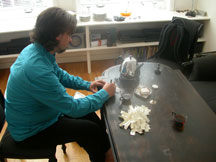
The lectures are usually held in private homes. The idea of a room as a meeting place enables the friendly sharing of experiences and ideas, elaboration of new travelling projects, finding others in a common, artistic and social manner. This visionary character of art is the underlying basis of the Milena. During these meetings small multidisciplinary exhibitions are also held. These expeditions have a high 'laboratory value' and the performances, installations, drawings, poetry and discussions take place in an organic way. It is this continuous experimenting with different possibilities that leads to a specific place.
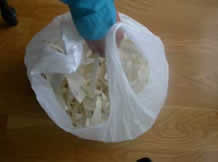
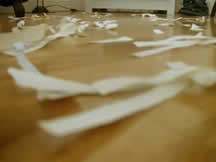
On Sunday morning 23rd July Niki Fröhling opened her house for the invitees. Hundreds of strips of paper from the pages of a book were scattered on the parquet floor. Everybody walked on these words. A few hours earlier Geert Vermeire had written one word on several of these strips of paper. These were lying on a table, around which the guests could sit, talk and eat together. The art and the house merged, the centre of the exhibition was a big table in the living room, where the artists and visitors exchanged ideas. The sensual elements and enjoyment was reflected in a feast, that was shared with the visitors coming and leaving the table of meetings.
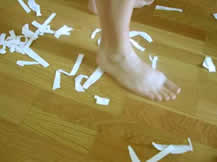
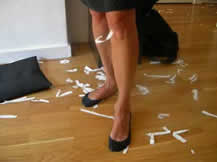
Geert Vermeire and Stefaan van Biesen staged a (sitting) performance 'Unisound'. Their silence imposed silence upon the people present. After this long silence the first word was spoken, they then conversed with each other by means of short poetic sentences. They gave literary improvisations, illustrating expressive landscapes and provided a dreamy reflection on their visit to this city and past ‘Gepäckträger’ (= Luggage carrier) experiences. This was something that was very much appreciated. A number of fragments from the letter cycle ‘Bewoner van steden’ (= Resident of cities) was read by Stefaan van Biesen and Geert Vermeire. One of these letters had been written on the spot by Geert Vermeire the day before this occasion.
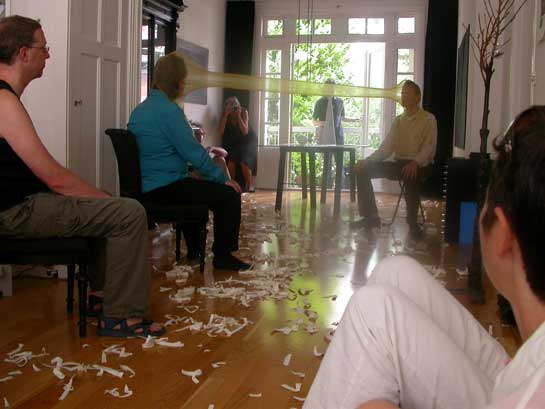
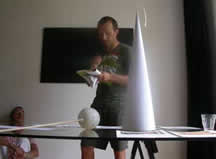
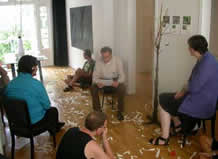
performance 'Unisound' Geert Vermeire + Stefaan van Biesen.
Filip Van de Velde gave an explanation of his E=Mc² performance as well as a lecture on phenomena with the cloister of Le Corbusier in Evreux in France as the central idea.
SinfoSaramago [ José Saramago ]
José Saramago – 90 years / Sensitive islands A triptich in Gent – Lisbon – Braga in collaboration with the Saramago Foundation Lisbon, the Museu Nogueira da Silva Braga in the framework of the project SinfoSaramago A meeting in S.M.A.K. [24.11.2012], was the introductory event for a series of events in Belgium and Portugal dedicated to the connection between arts, literature, society and environment. Within the festive program for the 90th birthday of Saramago the Milena principle is invited for performances and conferences about their European projects and about their collaboration with the National Library in Brasilia, the National Museum of Brasilia and the International Bienal of Literature in Brasilia in 2011 and 2012. Stefaan van Biesen and Geert Vermeire made connections with the world of Saramago in art events for these institutions in Brasil. Also the artists Enrique Tomás and Yiannis Melanitis will talk via Skype about their exhibitions in Brasil and the connection with Saramago. These exhibitions were curated by Geert Vermeire in collaboration with Dr. Simona Vermeire. Also noTours, geolocated literature will be part of the event. Other speakers are Pilar del Rio, Sérgio Letria, Augusto Rodrigues (Brasil), Ana Clara Medeiros (Brasil), Rosario Girão (Portugal) in Lisbon, Casa dos Bicos, december 15th. In Braga, Museu Nogueira da Silva, december 19th with Stefaan van Biesen, Geert Vermeire, Simona Vermeire, Augusto Rodrigues (Brasil), Ana Clara Medeiros (Brasil). A co-production of the Milena principle with the Saramago Foundation Lisbon, the Museu Nogueira da Silva Braga in the framework of the project SinfoSaramago (coordinator Dr. Simona Vermeire).
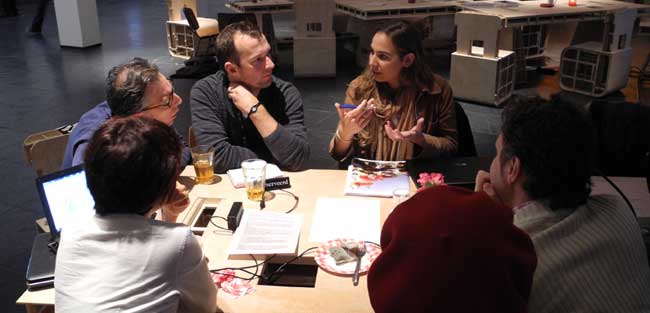
Simona Vermeire, Stefaan van Biesen, Filip Van de Velde, Lynn Louise Pauwels, Paula Ximenes, Geert Vermeire and Annemie Mestdagh at S.M.A.K. [24.11.2012] Ghent Belgium, talking about the project.
Introduction SinfoSaramago Project - 2011 Universidade do Minho
the Dürer connection: uma orelha sobre a relva / Uma biblioteca imaginaria (Brasilia, Biblioteca Nacional - October 2011).
Exhibition about the library as a space of imagination, writing performances on video and video poetry in the National Library of Brasilia with the concepts of travelling as an artistic instrument and thematically connected with the novel Blindness of José Saramago. Artists: Stefaan Van Biesen, Geert Vermeire and Yiannis Melanitis. Curator: Geert Vermeire. Literary Consultant: Simona Vermeire. In collaboration with EUNIC – European Union National Institutes for Culture and UnB – University of Brasilia.
O escritor no espaço publico [Brasilia, Biblioteca Nacional - October 2011].
Lectures and workshops about art and literature in the public space. Simona Vermeire, Yiannis Melanitis, Enrique Tomas, Stefaan Van Biesen, Geert Vermeire. Keynote speaker Simona Vermeire : “O corpo patenteado na obra de José Saramago”.
Out of control [Athene, Athens School of Fine Arts - November-December 2011].
Lectures and workshops by Simona Vermeire and Geert Vermeire leading to artistic creations by students of ASFA inspired by Blindness of José Saramago.
Ilhas do Corpo [Brasilia, Biblioteca Nacional & Museu Nacional - March 2012].
Simona Vermeire participates with the conference “The island of the body” which proposes an interdisciplinary reading of the novel “The Stone Raft “ by José Saramago. Her approach is to connect the concepts conveyed in the performances of the participating artists : a new writing of the body (the body reinvented genetically) preserved in ice, as in the variant of the literary interpretation by Saramago of Kryographia, and embryonic representations as insularity of the biological body connected with the geographical body of world (Portugal interpreted as the embryo of Brazil). A third geographic and metaphoric topic, Antarctica, will be explored in a series of poetic video-interventions of Geert Vermeire. The conference will have a “conclusicive” visual interpretation by the Belgian artist Stefaan van Biesen that will show a an artistic earth globe "re-written" with bio-literary spellings.
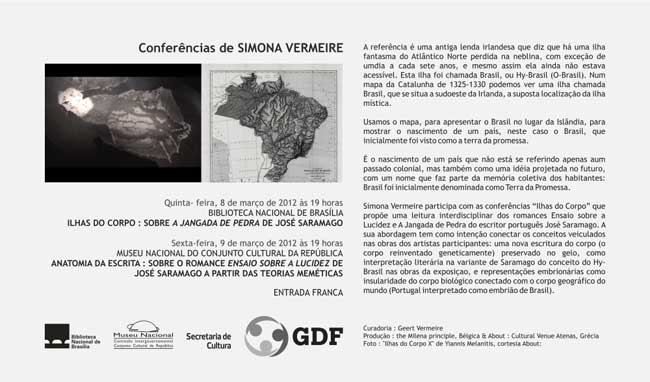
Hy-Brasil [Brasilia, Biblioteca Nacional - March 2012].
Exhibition of Yiannis Melanitis in the National Library of Brasilia connected with A Jangada de Pedra by José Saramago. Curator: Geert Vermeire. Literary consultant: Dr. Simona Vermeire.
Part of the interdisciplinary project “Rewriting the body” : an art project in which writing is presented as a metaphor for the absolute coldness and a creative research to mythical and etymological origins of Brazil, seen as an imaginary island (Hy-Brazil) inspired by the traditions of medieval Ireland and the works of James Joyce and Jose Saramago. Installation, performance, exhibition of visual arts, literary conferences connected with the incorporated act of writing.
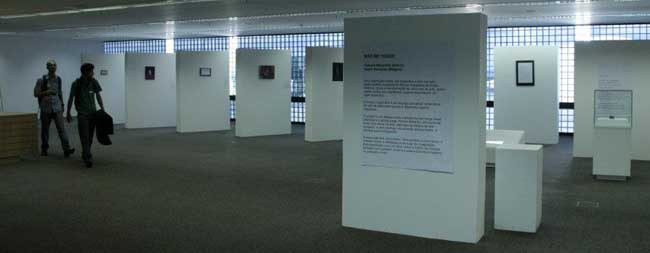
Anatomia da Escrita / Rewriting the body [Brasilia, Museu Nacional & 1ª Feira internacional do Livro e Leitura Brasilia - March-April 2012]. A triptich of Kryographia – Antarctica – the book of wonderings. The installation “Kryographia “by Yiannis Melanitis presents the act of writing as a state of absolute coldness. The writer, collector and producer of ice, constructs an insulated situation in order to capture the ultimate work, starting from Finnegans Wake of James Joyce. Through the use of water, he tries to transcend the entropic situation of the space, to create a new thermodynamic order. The work has the structure of a human body where each transformation of ice to water corresponds to vital human organs.
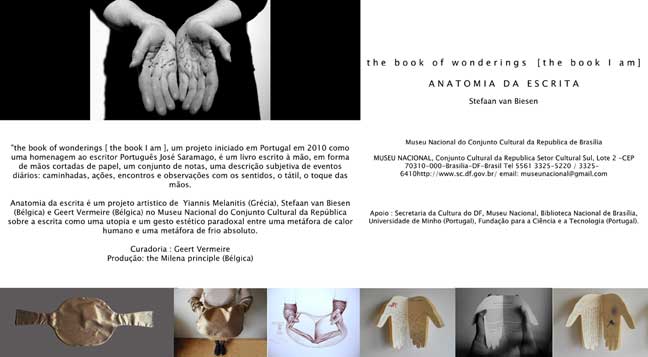
“Antarticta” [videopoems – Geert Vermeire and Stefaan van Biesen] and “the book or wonderings” (Stefaan van Biesen) complete the exhibition about the body and writing with a handwritten book, in the form of paper cut hands, an ensemble of notes, a subjective description of everyday events: walks, actions, meetings and observations that depart from the tactile. The paper cut palms also refer to the performance 'the Go-between' of Stefaan van Biesen in the museum Nogueira da Silva [Braga, Portugal 2010] where the artist covered his eyes covered with his palms and used them as an imaginary book. After a present silence, the audience heard the first sentence: 'I am reading a book', a homage to the work of José Saramago.
We become panoramic : 360 º travelling spaces [Brasilia. 1ª Feira internacional do Livro e Leitura Brasilia - May 2012]. A sound- and video installation inspired by “the unknown island “ of José Saramago.
Interactive technology allows the public to become part of a and panoramic and poetic sound and image experience of 360 º which moves with the orientation of the listener via a rotating chair.
Four natural soundscapes follow the movement of the listener. Speakers reproduce the audio contents that are mixed on an organic way, depending of the point where you are listening. The experience occurs in a rhythmic dialogue with a panoramic projection of various videos, video poems, video-performances and soundscapes, created for this installation by Stefaan van Biesen and Geert Vermeire. The flow of the text by Saramago is rewritten in a flow of sound and image activated by a person in a rotating chair, symbolizing the searching man of the fairy tale, and is transformed into a travel to an inner world.
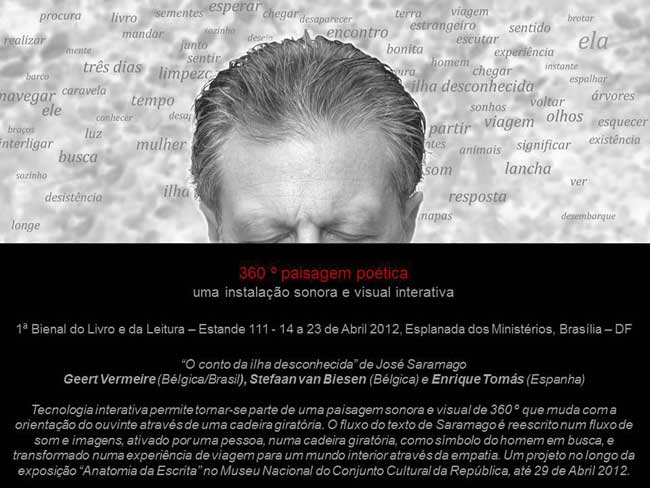
Sensitive islands [Lissabon, Casa dos Bicos – Fundaçao José Saramago and Braga, Museu Nogueira da Silva / Universdidade do Minho - December 2012].
Lectures, presentations and public talks with Pilar del Rio by Simona Vermeire, Geert Vermeire and Stefaan Van Biesen about creative fields of people and the connection with the work of José Saramago.
Rooftop Farming ⋈ greening the cities.
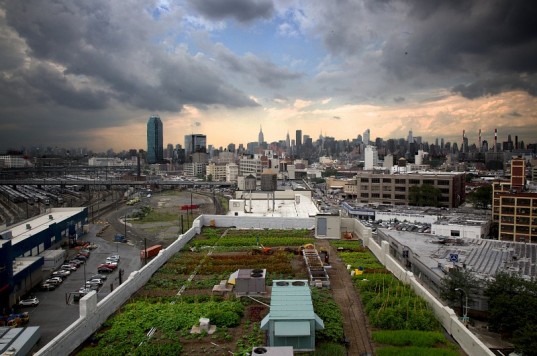
Brooklyn Grange is the product of Wisconsin native and Head Farmer Ben Flanner, who in 2009 started the Eagle Street Rooftop Farm, the first rooftop soil farm in NYC. Flanner’s interest and passion for farm-to-table food led to a farming team with roots in the restaurant business. The owners of Roberta’s in Bushwick, Chris Parachini and Brandon Roy, as well as restaurant veteran Anastasia Plakias, sustainable food advocate Gwen Schantz, and the team’s first apprentice Rob Lateiner, in addition to dozens of volunteers, all contribute to the farm’s growing success. The team partnered with Bromley Caldari, a NYC architect firm dedicated to problem solving, and Acumen Capital Partners, a private company dedicated to the reuse and sustainable renovation of commercial spaces in New York City. Acumen has leased the warehouse rooftop to Brooklyn Grange for 10 years. Brooklyn Grange‘s organic produce is grown in 7.5” deep beds with Rooflite soil. Produced by Pennsylvania soil company Skyland, Rooflite is a lightweight soil composed of organic matter compost and small porous stones which break down to add trace minerals that are needed for the produce to grow into a healthy and mature state. The use of organic soil means that everything produced by Brooklyn Grange is sustainable and good for you. The farm had a nine-month growing season last year, and during the winter, they used cover-crops such as rye, buckwheat, vetch, and clove, resulting in a year-round production of organic goodness right in the heart of NYC!
Ben Flanner and his team are community oriented which has helped the young for-profit business succeed. The farmers at Brooklyn Grange hope to reconnect the city to its farms and farmers by improving city citizens’ access to good, healthy food. Ultimately, the team’s goal is to show that urban farming is a viable enterprise and livelihood that contributes to a sustainable economy and the health of the city. The produce is available for everyday New Yorkers as well as businesses, which in addition to Roberta’s include Vesta in Astoria, Marlow & Sons in Williamsburg and many others throughout the city. Brooklyn Grange is looking forward to expanding to many more roofs to help increase the education and training available to those interested in urban farming.
To get involved with the farm, visit Brooklyn Grange’s website. Read more: Brooklyn Grange is the World's Largest Rooftop Farm! | Inhabitat New York City